
The Indian rupee fell to a record low against the US dollar due to rising crude oil prices, foreign institutional investor selling, and weak domestic equity market sentiment.

The Indian rupee depreciated by 52 paise to settle at 93.35 against the US dollar, driven by failed US-Iran peace talks, surging crude oil prices due to a potential US blockade of Iranian ports, and a global flight to the greenback. This geopolitical uncertainty is also leading to foreign capital withdrawal from domestic equities.

However, Tata Consultancy Services, Infosys, Tech Mahindra, UltraTech Cement, IndusInd Bank, Hindustan Unilever and ICICI Bank were the gainers.

Iran's national football team is training in Turkey for upcoming friendlies as they prepare for the FIFA World Cup, facing heightened attention due to geopolitical tensions.

The Indian government has increased import duties on gold and silver from 6 per cent to 15 per cent to curb inbound shipments of precious metals amid a rising import bill due to the West Asia crisis.

Karnataka's Chief Minister Siddaramaiah has requested Prime Minister Narendra Modi to take measures to protect Indian citizens in the Middle East due to escalating geopolitical tensions, including initiating evacuation plans and enhancing diplomatic efforts.

India and Australia have signed significant agreements covering civil nuclear energy, maritime security, and critical minerals, reinforcing their partnership's role in ensuring a peaceful Indo-Pacific. The pacts facilitate uranium supply from Australia to India and enhance cooperation in defence, cyber, and critical technologies.

Indian stock market indices Sensex and Nifty experienced a significant decline, driven by rising crude oil prices, sustained foreign fund outflows, and selling pressure in major bank stocks.

India and the US are reportedly exploring a potential meeting between Prime Minister Narendra Modi and US President Donald Trump on the sidelines of the G7 summit in France next week, aiming to rebuild bilateral ties after recent tensions.

'Buy on dips, buy on dips and sell on rise.'

Companies are already diversifying sourcing, raising prices, and reworking operating models as the disruption drags on.

Analysts predict that the ongoing US-Iran conflict, fluctuations in crude oil prices, and foreign institutional investor (FII) flows will be the primary factors influencing Dalal Street this week, with inflation concerns adding to investor anxiety.

Prime Minister Narendra Modi has begun a six-day tour of the UAE, the Netherlands, Sweden, Norway and Italy to strengthen bilateral relations amid geopolitical challenges. The trip will focus on energy security, trade, and technological cooperation.

Tensions escalate between Iran and the US following an attack on an Iranian commercial vessel in the Sea of Oman, with both sides trading accusations over maritime security and ceasefire violations.

Silver prices rallied sharply by Rs 15,000 to hit a lifetime high of Rs 265,000 per kg in the national capital on Monday, and gold advanced to a fresh record of Rs 144,600 per 10 grams, mirroring strong gains in the global markets.

For the foreseeable future, the most likely outcome remains continuation of the status quo. Taiwan will remain self-governing without formally declaring independence, while China continues to apply sustained pressure short of war, predict Krishnan Srinivasan and Manoj Mohanka.

The Beijing summit may have reduced immediate diplomatic uncertainty, but it did not resolve the deeper structural contest between the United States and China. That contest appears likely to define the coming decade, notes Varun Arya.

Amid rising tensions, Iran reportedly launched ballistic missiles toward a US-UK military base, prompting concerns about regional stability and the potential for escalating conflict in the Middle East.

The claycourts of Roland Garros were transformed into a complex geopolitical chessboard on Tuesday as they produced a French Open semi-final lineup featuring a number of emotionally charged matches in the shadow of Russia's war in Ukraine.

'Tightening of visa norms for international students around the world are a concern for the university and the education sector, even as the UK continues to offer relatively attractive post-study work opportunities compared to several competing markets.'

Prime Minister Narendra Modi and Indonesian President Prabowo Subianto have significantly advanced the India-Indonesia Comprehensive Strategic Partnership, securing crucial agreements on defence, critical minerals, and maritime security, including BrahMos missile supply and Sabang port development.
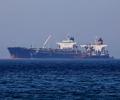
Iranian forces fired upon three commercial vessels in the Strait of Hormuz, with one possibly headed for Gujarat, raising concerns about maritime security in the strategic waterway.

Prime Minister Narendra Modi and US President Donald Trump exchanged pleasantries and held a brief conversation at the G7 summit, their first in-person encounter in 16 months, setting the stage for high-stakes bilateral talks amidst continuing strain in India-US relations.

It is an unusual choice to depute a retired general for the funeral of a revered religious figure but a thoughtful one in an attempt to inject verve into the bilateral relationship and restore the equilibrium in India's West Asian policies, notes Ambassador M K Bhadrakumar.

Global risks include a potential delay in the US-India trade agreement, the possibility of a sharp correction in US equity markets, and renewed geopolitical tensions.

Preferential equity listings in India reached an unprecedented 1,307 in FY26, marking a 33% increase from the previous year and reflecting a strategic choice for companies during market volatility.

Precious metal prices, particularly gold and silver, experienced a significant surge in the national capital as investors sought safe-haven assets amid escalating hostilities in the Middle East.

Delhi should keep all its options open in what is essentially a transitional period in the geopolitics of energy rather than remain a gatekeeper serving Trump's 'America First', suggests Ambasssador M K Bhadrakumar.

Analysts are revising down India Inc's financial year 2026-27 (FY27) earnings growth forecasts, citing persistently high crude oil prices above $100 a barrel due to the West Asia conflict, which is expected to dent corporate financial performance in the coming quarters.

Chinese President Xi Jinping has called for the Strait of Hormuz to remain open for normal passage of ships, describing it as an 'international waterway' amid rising tensions between the US and Iran.
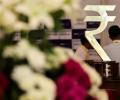
The Indian rupee rebounded against the US dollar following intervention by the Reserve Bank of India, amidst ongoing concerns about foreign capital outflows, rising crude oil prices, and geopolitical instability.

Elevated global crude oil and natural gas prices, driven by geopolitical developments in West Asia, could significantly influence the Government of India's fiscal position for 2026-27, according to a report by ratings agency Icra.

'Travellers are considering safer and more stable destinations.'
Indian stock markets tumbled sharply with the Sensex falling 800 points and nearly 4 lakh crore wiped out in a single session. Here are the 6 key factors, including rupee weakness and global cues, behind the crash.
Benchmark indices Sensex and Nifty tumbled in early trade on Friday after a two-day rally, tracking a weak trend in global peers, as the US-Iran conflict continues to be a key overhang for the markets. Track Sensex, Nifty50 movement and key market drivers for March 27, 2026.

The Indian rupee depreciated significantly against the US dollar, reaching a new all-time low due to rising oil prices, a strong dollar, and ongoing geopolitical concerns. Domestic equity market declines and foreign investment outflows further contributed to the rupee's weakness.
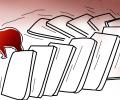
Markets face risk of a prolonged bear phase as oil shocks and geopolitical tensions test inflation, growth and investor confidence globally, points out Debashis Basu.

Indian airlines are expected to cancel 444 international flights due to airspace restrictions in the Middle East following attacks on Iran by Israel and the US. The civil aviation ministry is closely monitoring the situation and coordinating with airlines to ensure passenger safety and minimize disruptions.

Indian stock market benchmarks, Sensex and Nifty, saw gains in early trading, driven by anticipation surrounding the Reserve Bank of India's monetary policy decision, despite mixed global cues and significant FII outflows.

Petrol and diesel prices in India have been increased for the second time in a week, following a long freeze on revisions. The increase comes as global crude prices surge and state-run oil firms look to recoup losses.
